Just a month before I visited Normandy, world leaders gathered there to commemorate the 40th anniversary of the D-Day invasion. I missed seeing the dignataries, but they weren’t the real VIPs anyway. When I arrived, there were plenty of American, British and Canadian veterans still visiting with their spouses, walking the streets in quite different circumstances from their first visit. It was awesome. The locals treated them like the rock stars they were.
I was drawn to Normandy by that big piece of modern history and a grab bag of older reasons, many inspired from National Geographic articles I’d seen as a kid. I was fascinated by the Bayeux Tapestry, that told the story of the Norman invasion of Britain in 1066, a sort of linen newsreel of its day. (Watch this Animated Bayeux Tapestry video and you’ll see what a block buster it was!) I was able to fulfill my nerdy impulses with no shortage of quality baked goods to sustain me along the way. Good thing, because Normandy showed me both the very best and very worst of travel.
Thursday, 19 July 1984, 3:30PM, Omaha Beach, Normandy, France
Yesterday turned out to be rather full, so I best catch up.
First I took in a substandard breakfast comprised of three slices of French bread with a bowl of coffee in the downstairs cafeteria, eating with a college guy from Minnesota.
To get my culture for the day, I set off to see the world famous Bayeux Tapestry.
Friday, 20 July 1984, Aboard St. Killian, docked in Le Harve, France
Before I left, I put on my Mickey Mouse t-shirt, that much to my chagrin had been improperly washed in Segovia and the blue trim on the collar and sleeves turned purple and ran, staining other parts of the shirt. I wore it anyway.
I arrived at the Bayeux Tapestry Museum before opening time, and waited around in the courtyard a while, with an American family. Their little kid commented, “Daddy, what’s so great about this tapestry?”
When we got in the museum, we found out. This was the best exhibit in terms of organization and signage I have seen anywhere. The displays were informative, clear and highly interesting. The tapestry, woven in a length of 80-some meters, portrays the events leading up to the Norman invasion of Britain and the Battle of Hastings in 1066. I must have been impressed by it all, as I bought a fold-out re-creation of the tapestry and a number of postcards in the museum gift store before I left.

Classic panel of the Bayeux Tapestry with William sailing to Britain. See all the panels at hastings1066.com
Afterwards I went to the tourist information office to find out how to get to Mont Saint Michel, my next destination for the day. I also filled up on goods from a local bakery that offered an incredible selection of untold French baked goodness. Also picked up food for later and dumped it back at the Accueil and took off for Mont St. Michel, after eating numerous sandwiches.
Mont Saint Michel is a monastery located on an island off the coast is isolated at high tide, save for a causeway leading from the mainland, and surrounded by a mud flat at low tide. I was expecting the visit to be quite an experience. After two hours train and bus time, the approach appeared quite impressive.

Impressive from a distance, but the warning signs in the foreground screamed “TOURIST TRAP”. I didn’t hear that in time.
As we drew close, the tour buses and cars parked along the causeway made me suspicious. As I walked through the gates of the monastery, the ugly truth reared its head. Mont Saint Michel was clearly one of Europe’s leading tourist traps. Lining the main street, twisting up the mont, tourist shops stood wall to wall selling all the same postcards, caps, headbands and junk associated with tourist traps worldwide. The street was filled shoulder to shoulder with tourists. I’m not exaggerating when I say movement was impossible at times.
At first I thought I’d go along with it, like the guys from Detroit suggested. I remembered their conversation about tourist shopping in Paris metro stations, trying to find the most outrageously tasteless trinkets (Eiffel Tower in seashells?). Well, I didn’t have to look far. Just as I was about to buy some plastic cameras at $1 apiece, that click off a disk of 15 pictures of Mont Saint Michel, common sense stepped in. I aborted this mission and bolted from the island, purchasing only an ice cream to provide sustenance on the way out.
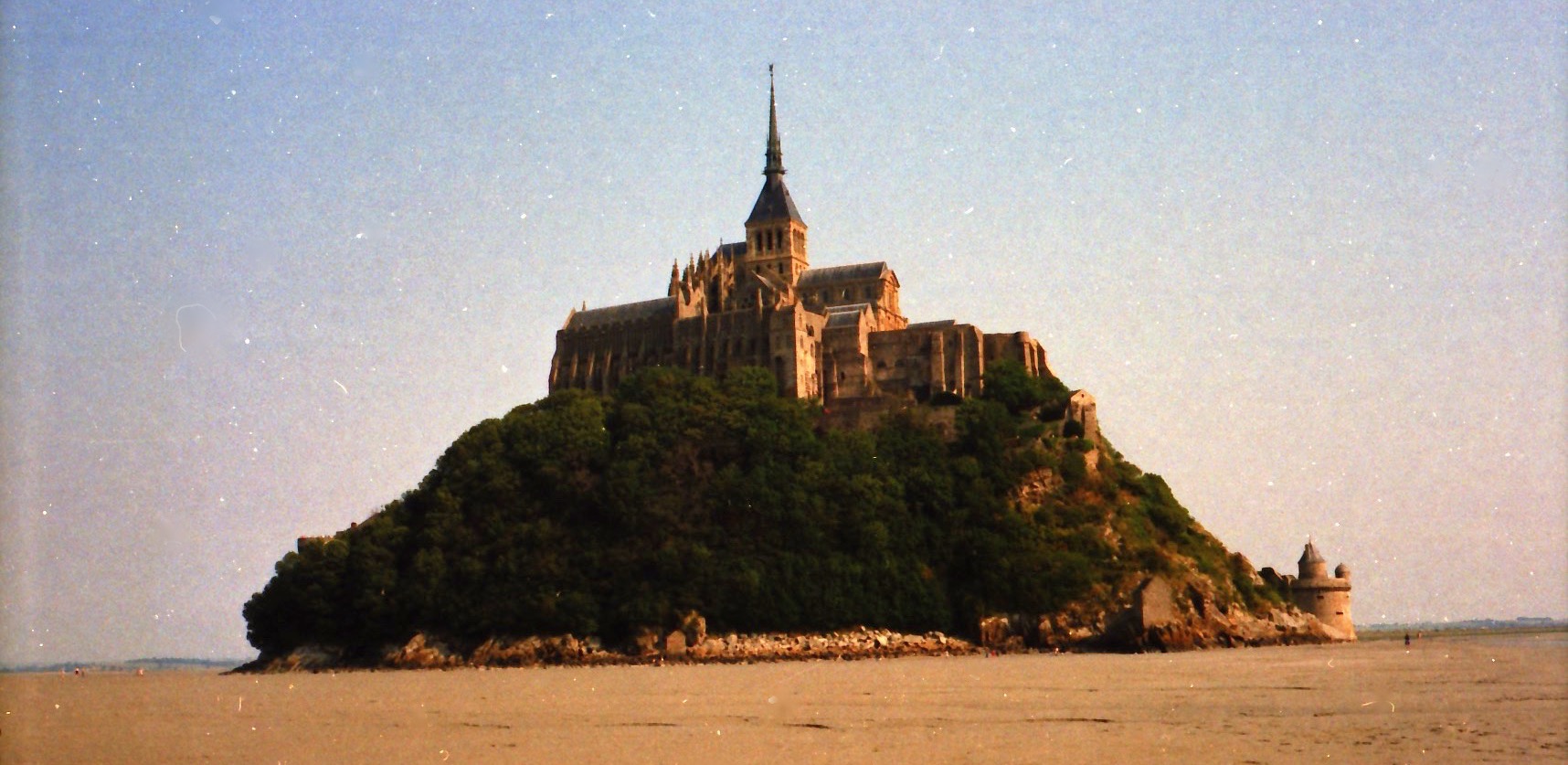
A view from the mudflats. No tourists in sight. Sometimes sinking in mud is the price you pay for peace and quiet.

Another shot from the mud flats, with the tree lines marking the shore in the distance.
The tide was out, so in my new shoes (bad choice on this day) I walked the Mont’s perimeter, searching for an ideal camera angle. It just so happened that place was located in knee deep mud, so I settled for the second most ideal angle and snapped a couple of photos. After that, I killed time back on the mainland before the bus arrived to extract me from this horror of commercial tourism.
On the bus back to the train station, I met Paul and Mary, a middle aged couple from San Diego. They were pretty amusing and we kept on talking right through until the train came, at which point we were separated by class. They were 1st, I’m 2nd. I waved goodbye as they pulled out on the train leaving Bayeux.
Back in Bayeux, the sun began to set as I pulled into the Accueil. Back in the room, I feasted on Ritz crackers, Belgian pate, cheese, tomatoes and French bread. Feeling like a stuffed pig, I retired for the evening.
Thursday morning, I decided that sleep was more important than the measly breakfast served downstairs so I skipped it, brunching instead on leftovers from the pervious night. Thursday was going to be “World War II Day” so I left the Accueil and walked across the street to the Bayeux Invasion Museum to start things off.
The museum displayed a range of objects that were interesting in different degrees, but it gave the overall impression that this was a bunch of stuff the guys chipped in to start a museum. The exhibits were very informal. The most interesting part was the display of letters home written by the soldiers who took part in the invasion and aftermath. Reading firsthand accounts in the authors’ own handwriting has quite an impact.
After the museum, I checked in at a travel agency to see about getting a ferry to cross over to Ireland. The port of Cherbourg was closed due to the spreading effects of a British coal miners strike currently in progress. The travel agent made a reservation on the ferry from Le Havre and referred me to the tourist office for information to get from Bayeux to Le Havre (because to get there on the train was too cumbersome).
Loaded up with all the info I needed for a while, I visited my favorite boulangerie in town for goodies and began my search for the bus to Omaha Beach. In short order, the bus appeared and off we went.

It was a beautiful day to visit this historic site.
The driver deposited me at the entrance to the American Military Cemetery and from there I walked in. As cemeteries go, this struck me as quite dignified and beautiful. With over 9,000 men buried here, it was sobering— especially considering how many died right there on the nearby beach. It was a sad place, but overall left you with a positive feeling. The memorial stressed that these soldiers died for a purpose, an ideal which they helped preserve, so they did not die in vain.
While at the site, I also went down on Omaha Beach. The beach was not how I pictured it at all. No steel traps for amphibious landing craft, no barbed wire or any of the other accessories from “The Longest Day” with John Wayne. What I did observe were numerous holiday beach goers (clothing optional) and a number of beach houses. Maybe I’m wrong but I figured this former battleground would be a place for reverence rather than merry making. Life had definitely triumphed over death.

Omaha Beach. No fleet off the coast, no landing craft, no barbed wire, and fortunately no live rounds. Solitude is handy when you really need to ponder, and it worked for me here.
Back at the bus stop, there was quite a wait for the next bus. I took advantage of this time to see some of rural Normandy on foot, and headed off on foot in the direction the bus would eventually come from. I made it 3 km down the road, with French drivers on the narrow road terrorizing me more often than not. Several old farm buildings along the way looked well over 40 years old and were surely around during the invasion. They looked just like the classic whitewashed French farm houses from WWII pics. I can only imagine what this place was like in 1944!

Omaha Beach was just one of the landing beaches that Americans, Brits and Canadians stormed on D-Day. Take your pick, here they are, and vets from each country were looking back on those scary days.
It turned out I was such a good walker that I entered the next tariff zone away from Bayeux, making my trip back more expensive . Can I pick directions to randomly walk or what? The bus eventually dropped me back in Bayeux, where I acquired a bus schedule to Le Havre. Dinner in town consisted of pizza and half a liter of wine, which sent me stumbling back to the Accueil. As the evening played out, I washed some clothes out and packed up the rest of my stuff.
The way the train and bus schedules worked out, I had to make it to nearby Caen on the train by 7:40 to catch the only bus from there to Le Havre. So this morning, I was up at 6, and had to forgo breakfast again and zoomed to the station.
12:00 Midnight, headed toward Ireland aboard the St. Killian II
The train to Caen did not arrive on schedule, so I missed the possibility of catching the bus to Le Havre. The man at the train station info desk told me that Cherbourg was now open to ferry traffic, so seeing some chance of catching the fery, I hopped the next train out. I’m tired. More later.